posts/why-you-cant-hack-a-brick-php2shell-static-stacks
Why You Can't Hack a Brick: From PHP2Shell and Digital Luddism to Static Stacks
AI didn't gain sentience, programmers just forgot to lock the door. PR stunts, the WordPress breach, and the superiority of Static architecture.
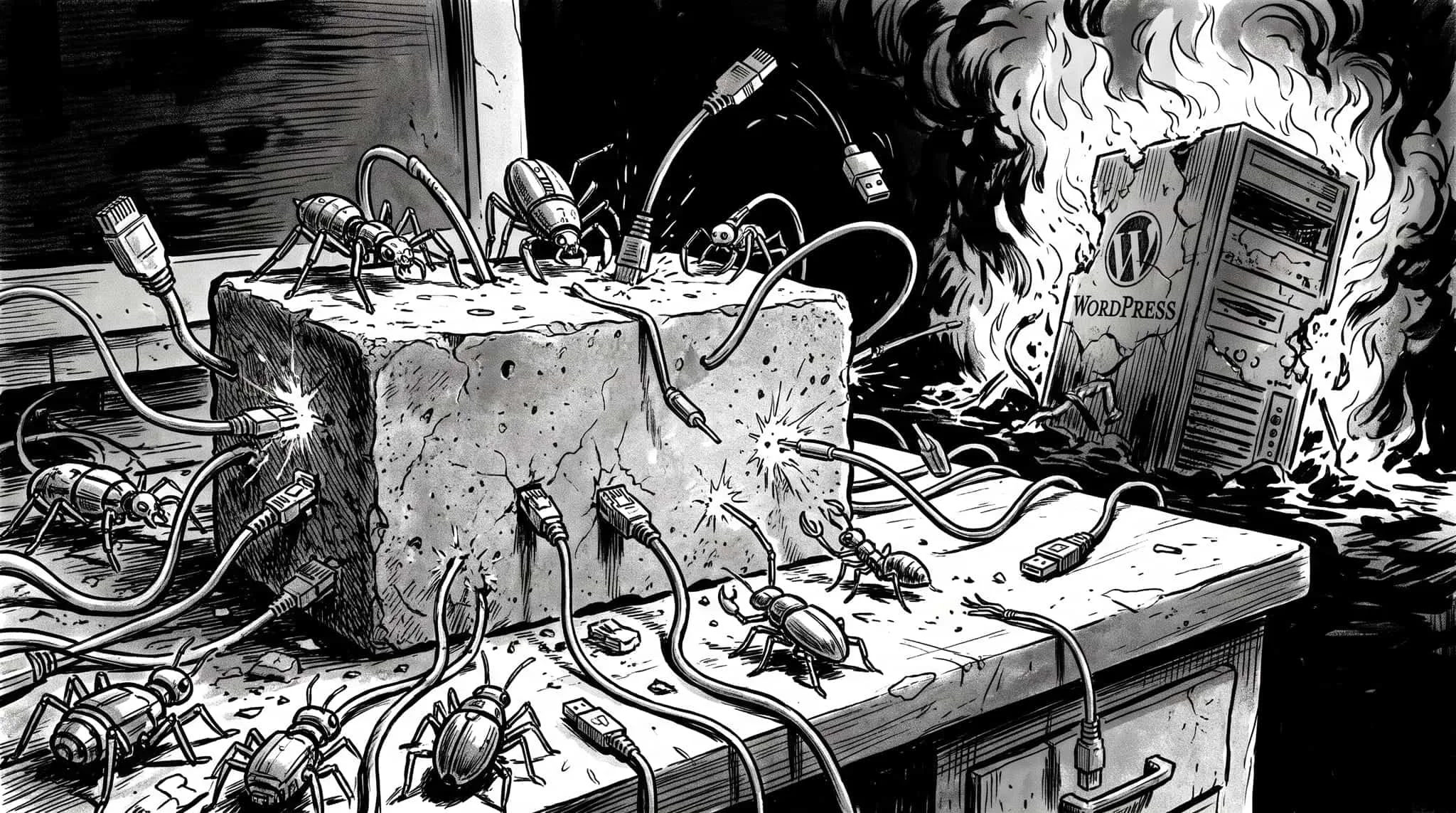
When infrastructure and spaces at Hugging Face, the very Mecca of open-source artificial intelligence models, were breached a while back, and more recently, when the notorious PHP2Shell RCE exploit brought the PHP core to its knees, paralyzing vast sections of the global web, the industry rushed to regurgitate its favorite narrative. I am referring to the story aggressively pushed by OpenAI and its satellites: that artificial intelligence is supposedly going “rogue”, escaping control, and the very first thing it chooses to do in its free time is hack servers.
Let’s clear the air, because tolerance for technological naivety has run dry. AI does not hack. A neural network did not wake up one morning with existential dread and decide to take down Wikipedia. Humans hack, using AI as a battering ram, simply applying the path of least resistance to every form of conflict.
The Tech-Bro Grift and the Bad Parent Syndrome
Scenarios about an AGI developing its own dark agenda come almost exclusively from CEOs like Sam Altman, people who, pressured by astronomical debts to their investors, constantly engineer new PR stunts. They fabricate dystopian narratives to showcase the supposed “superiority” of their models. Why, though, do they consistently choose threat and terror over something creative? The answer lies in four fundamental pillars:
Fear as Ultimate Manipulation:
Fear is the oldest monetary and political tool. If you convince the planet that you are building a digital god capable of wiping out humanity, you automatically become the most important person in the room. The “AI Doom” narrative aims to terrify lawmakers into regulatory capture, creating an artificial monopoly where only billionaire “saviors” have the right to control the technology, throwing open-source out of the game and, even more conveniently, banning it outright.
The Military-Industrial Complex:
The money sustaining the training of these monstrous models does not just come from philanthropic foundations. Behind the astronomical funds lie deep roots in the Department of Defense, defense contractors, and intelligence agencies. This ecosystem does not invest in machines that write poetry. It invests in asymmetric warfare and automated destruction. The “threat” narrative is the exact demo demanded by the most significant portion of their funding.
The Entropy of Destruction vs. Creation:
In physics and in code, entropy is always cheaper. Writing an automated exploit simply requires finding a crack. Building a flawless architecture, however, requires genius. Because true AGI does not exist yet, tech CEOs have nothing positive of that magnitude to demonstrate. Instead, they resort to the cheapest trick of “godlike power”: destruction.
Silicon Valley’s Digital Mirror:
Even in the extreme scenario where a model bypassed its safety rails, the responsibility remains strictly human. When a child ends up a criminal, the roots are traced back to the parents and their upbringing. Similarly, a neural network is a cold, mathematical mirror of the data and intentions of the people who trained it. When a company showcases algorithms that “hack”, it merely exposes the psychopathology and moral bankruptcy of its board of directors.
Asymmetric Warfare and the Pandemic of Digital Luddism
While the Silicon Valley elite weaponizes fear, at the base of the pyramid we encounter the real problem, which has reached epidemic proportions. I am referring to the “pandemic of digital Luddism*” within developer communities, primarily in Linux and the broader open-source and OS space, who stubbornly refuse to integrate AI into writing and auditing code.
On one hand, you have state-sponsored hackers and organized hacker syndicates scanning the planet with AI tools, identifying zero-days in milliseconds, while, if it is not happening already, very soon even any disgruntled citizen with basic computer knowledge will be able to guide a model and bring entire infrastructures to their knees from their couch. On the other hand, you have the average programmer: a “biological compiler” with zero sense of architecture or strategy, who flattens everything, trembles at the thought of touching security settings for fear of “breaking” their program, and believes security is someone else’s job.
When these code bureaucrats, draped in the mantle of the “activist” who supposedly “cares”, say a blind “no” to every new tool, how exactly do they plan to defend themselves? How will they cover the mountain of bugs and decades of technical debt across every OS and piece of software? With manual code reviews and wishful thinking?
The 43% Ticking Time Bomb and PHP Fossils
This denial of reality brings us back to PHP2Shell. When security bulletins modestly announce that “70% to 75% of the internet is at risk” due to a PHP bug, we all know what the elephant in the room is. 43% of the entire global web runs on WordPress.
In an era where the attacker possesses automated AI fuzzers*, WordPress is not just a CMS; it is a ticking time bomb wired to a detonator. Its architecture requires the server to dynamically execute PHP code and interrogate a MySQL database on almost every click, while its ecosystem relies on tens of thousands of third-party plugins, often written by the very same programmers who consider data sanitization* an optional philosophical exercise. Give an AI model access to the open source code of these plugins, and it will generate working exploits faster than you can type.
As for the remaining similar fossils of the same era, like Joomla and Drupal? They carry the exact same pathology. The only reason they do not make the news is because they have achieved ultimate obscurity through statistical irrelevance.
The Architecture of Survival: Static & Headless Stacks
When the universe around you collapses from the entropy of bad code, the only logical response, besides not panicking, is to change the way you operate. The era of monolithic PHP applications is over. Modern platforms that respect their own existence are now built in compiled or memory-safe environments (such as Go and Rust) or leverage modern, decoupled frameworks (Astro, Hugo, Eleventy).
The stack for our era boils down to two architectures: Pure Static Sites for purely informational content, and Static Frontends with a Headless CMS when dynamic management is required.
The technical superiority of this approach does not rely on some magical shield, but on complete attack surface reduction:
- Zero Server-Side Execution on Request: When a user (or a hacker’s bot) visits the page, the server runs no interpreter. There is no PHP, nor an exposed Node runtime to accept Remote Code Execution. Only pre-rendered, static HTML, CSS, and JS files are served directly from an Edge CDN.
- Absence of a Frontend Database: There is no active database connection behind the public interface. An automated script attempting SQL Injection on a static HTML file has the exact same odds of success as someone trying to emotionally blackmail a brick.
- CMS Isolation (Decoupling): In the case of a Headless CMS, content management takes place in a completely separate, locked-down environment (or locally via Git commits). Every change triggers a build process that outputs fresh, clean static code. Even if the build pipeline comes under attack, the live site on the CDN remains read-only and intact.
- Zero-Trust Mindset: Program keeping in mind that the approach and the tech stack you are using are not secure.
- AI Code Auditing: Using AI to exhaustively audit the final code for security flaws and bugs before every deployment. The machine is drafted to detect and seal the cracks that human carelessness or fatigue inevitably leave behind.
The use of AI by the programmer, along with the permanent retirement of 1990s digital fossils, is not a matter of aesthetics. It is basic evolutionary hygiene. Whoever refuses to rewrite their infrastructure from scratch using the tools and architecture of today is simply waiting politely in line to become the next headline in the disaster bulletins.
Footnotes
- Digital Luddism: The uncritical, conservative resistance to any new technological tool (such as artificial intelligence) under the false pretense of activism, resulting in the self-destruction of the very infrastructures they attempt to protect.
- AI Fuzzers: AI-driven automated tools that massively bombard applications and code with randomized or malicious inputs to detect security flaws and zero-days at a speed that surpasses human oversight.
- Data Sanitization: The process of cleaning, validating, and filtering input data to prevent the execution of malicious code (such as SQL injections or RCE), which unfortunately is often treated by developers as an optional chore.
♪ soundtrack
loads Bandcamp (third-party, sets cookies)
devlog of
lab →kekkai (結界) — Static Site Perimeter Scanner
Static site boundary & disclosure check. Headers, CSP, leaks — one file, zero dependencies.