posts/why-norman-spinrad-remains-dangerous
Why Norman Spinrad Remains Dangerous
A deep dive into the anarchist universe of Norman Spinrad, from Bug Jack Barron and the utopia of Pacifica to The Iron Dream and his complete bibliography.
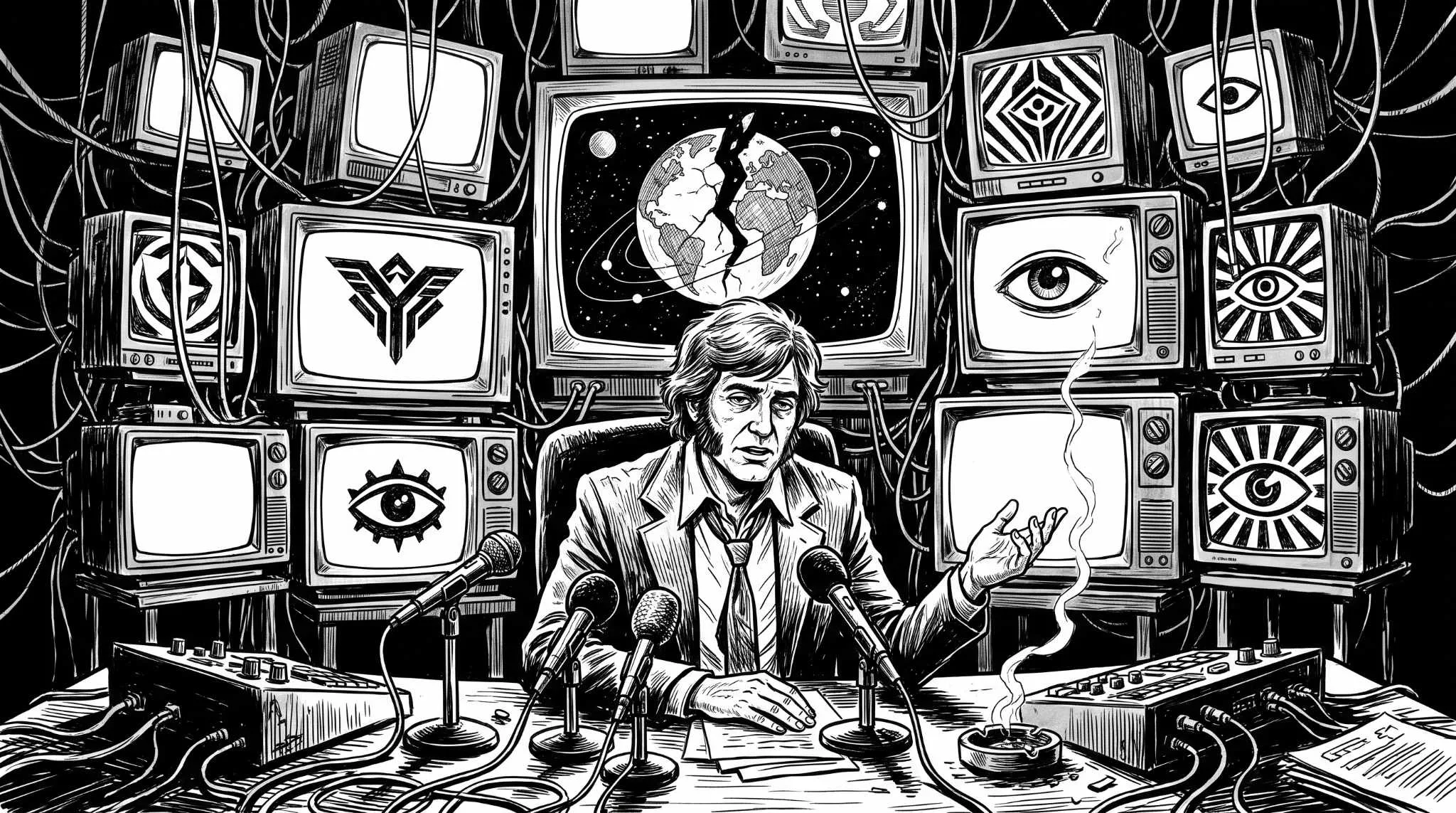
In the quiet waters of this digital river, far from the mechanisms that smooth down every sharp thought to turn it into digestible content, I often seek out those writers who refused to become cogs in the machine. Norman Spinrad never wrote science fiction to lull the audience with technocratic fantasies. He wrote to cause a short circuit. As a central figure of the 1960s New Wave movement, Spinrad took the genre out of the hands of conservative engineers and turned it into a battlefield of political satire, liberation, psychedelic exploration of consciousness, and the deconstruction of power.
Openly self-identifying as an anarchist, Spinrad understood decades before the advent of social networks that the true totalitarianism of the future would not necessarily wear jackboots, but would broadcast in high definition. Returning to his books and leafing through them for the kappa.yashi terminal, I feel that I am not holding mere stories of the past in my hands, but survival manuals within modern media cannibalism.
From the Bronx to Clashes with Censorship
Born on September 15, 1940, in New York City, Norman Richard Spinrad was intellectually shaped in the demanding environment of the Bronx High School of Science and later at the City College of New York, from which he graduated in 1961 with a Bachelor of Science degree. This scientific training never led him to technological complacency. On the contrary, it gave him the analytical tools to see how technology turns into a mechanism of social control when placed in the hands of oligarchies.
Despite his unconventional and often confrontational stance, Spinrad was a fierce advocate of collective action and his fellow peers in practice. He served two terms as President of the Science Fiction and Fantasy Writers of America (SFWA), from 1980 to 1982 and again from 2001 to 2002, and also led the international organization World SF. Beyond prose, he left an indelible mark on television history in 1967 by writing “The Doomsday Machine”, one of the most iconic episodes of the original Star Trek series, where a gigantic automated planet-destroying machine becomes an allegory for nuclear deterrence and the blind obsession of command. For his overall contribution, he was honored with the French Prix Apollo, the Jupiter Award, and the international Prix Utopia for lifetime achievement, while being repeatedly nominated for both the Hugo and Nebula Awards.
Criticism and Plots
The Solarians (1966)
In his debut novel, The Solarians, Spinrad takes the form of classic space opera and subverts it from within. The plot unfolds in a future where the human confederation is losing a desperate interstellar war against the Duglaari, an alien empire that operates on absolute, cold, computational logic. The Duglaari do not fight with passion or hatred, but on the basis of mathematical equations of attrition. When a star system ceases to be statistically advantageous, they abandon it; when they hold numerical superiority, they advance.
At this critical juncture, Earth, which had isolated itself for centuries from the rest of humanity while evolving its own secretive civilization of the Solarians, sends Commander Jay Palmer on a suicide mission. The critical value of the book lies in the way Spinrad juxtaposes algorithmic predictability with human chaos. Palmer understands that you cannot defeat a perfect computer by playing by the rules of mathematics, but only by introducing the absurd, the unpredictable, and the bluff into the system. It is the first seed of Spinrad’s philosophy against the tyranny of absolute logic.
Agent of Chaos (1967): Entropy as a Revolutionary Act
A year later, Agent of Chaos takes this idea to its political extreme. The plot transports us to a solar system controlled by the Hegemony, a totalitarian regime obsessed with order, security, and social uniformity. The Hegemony does not oppress citizens with raw violence, but through apathy and absolute control of information. Standing against it are the Democratic League, led by Boris Johnson, a revolutionary who realizes that frontal conflict is futile, and the mysterious Brotherhood of Assassins, a radical underground network.
The Brotherhood does not seek to seize power in order to impose a new order. Its goal is purely entropic: the injection of random disruptions into the social body so that humanity does not freeze into a static, dead perfection. Critically, Agent of Chaos is a purebred anarchist manifesto disguised as a pulp adventure. Spinrad argues here that freedom is synonymous with randomness and uncertainty, whereas any system that promises absolute order inevitably leads to spiritual death.
Bug Jack Barron (1969): The Blood Behind the Ratings
With Bug Jack Barron, Spinrad writes the masterpiece that caused a political earthquake. The plot follows Jack Barron, a former radical activist who has turned into the most powerful television host in America. His show, with a hundred million viewers, functions as a safety valve for social rage: citizens call in live to report injustices, and Barron exposes politicians and bureaucrats on the air. Yet Barron is now part of the system he once fought, a cynical power broker.
The conflict begins when tycoon Benedict Howards, head of the Foundation for Human Immortality, tries to pass a bill that will grant him a monopoly on cryonics. In order to buy Barron’s silence and political influence, Howards offers him what no human being can refuse: true biological immortality, both for himself and for his lost love, Sara. As the plot unfolds, the horrific secret of immortality is revealed: the treatment relies on glands harvested from poor African American children in the American South, who are systematically murdered so that the elites may live forever.
The book, written in a torrential, jazz, stream-of-consciousness rhythm, caused a storm when it was serialized in Michael Moorcock’s British magazine New Worlds. Members of Parliament brought the issue before the British House of Commons, denouncing the fact that state funds from the Arts Council were financing “filth and degeneracy”, while major retail chains W.H. Smith and Menzies banned its distribution. Spinrad’s gaze here is ruthless: the media do not merely represent politics, they are politics itself, and the spectacle literally feeds on the bodies of the powerless.
The Iron Dream (1972): Hitler as a Pulp Fantasy Writer
If Bug Jack Barron disturbed the establishment, The Iron Dream struck at the heart of the science fiction community itself. It is an ingenious metafictional satire, structured as a book within a book. In an alternate history, Adolf Hitler becomes disillusioned with politics in Germany and emigrates to the United States in 1919. There he works as an illustrator for pulp magazines and eventually becomes a famous science fiction writer. The novel we read is his supposed final work, written in 1953 shortly before his death, titled Lord of the Swastika, which even wins a posthumous Hugo Award.
The internal plot of Lord of the Swastika follows Feric Jaggar, a blond, genetically pure hero who returns to his homeland, the High Republic of Heldon, in a post-apocalyptic world teeming with mutants (“Dominators” who control minds and “Universalists”). Jaggar overthrows the weak government, acquires a phallic superweapon (the Great Truncheon), exterminates the mutants, imposes black leather uniforms, and ultimately abolishes sexual reproduction in favor of cloning a race of identical men, whom he sends in rockets to conquer the stars. The book closes with a pseudo-academic afterword by critic “Homer Whipple”, who analyzes Hitler’s work without fully grasping the horror it conceals.
Critically, The Iron Dream is a relentless deconstruction of the fascist subtexts and genetic fetishism that permeated much of early heroic fantasy and pulp literature. Spinrad forced the reader to realize how easily the typical structure of the “chosen hero who saves civilization from hordes of monsters” aligns with the Nazi worldview. The irony of history was monumental: in West Germany, authorities placed the book on the index of works harmful to minors, believing it promoted Nazism, until the courts recognized its anti-fascist satire, while American neo-Nazi George Lincoln Rockwell reportedly failed to grasp the irony altogether.
A World Between (1979) and the Planet Pacifica: The Utopia of Electronic Democracy
In 1979, with the novel A World Between, Spinrad turns his gaze to one of the most complex and prophetic sociopolitical experiments in his bibliography: the planet Pacifica. Pacifica is not a classic, static utopia, but a vibrant, dynamic electronic media democracy. Human colonists live there in peace, political equality, and complete sexual harmony, having overcome the old gender antagonisms of Earth. Planetary governance is exercised directly through a worldwide computer and media network, where every citizen has access to information and participates in decision-making via digital referendums.
At the helm of this open system are Prime Minister (Chairman) Carlotta Madigan and her partner, lover, and Minister of Media, Royce Lindblad. Their relationship reflects the very political philosophy of Pacifica: a balance between the pragmatism of governance and the free flow of communication, without censorship and without hierarchical imposition.
However, this delicate balance shatters when two off-world, fanatical factions arrive on the planet, viewing Pacifica’s freedom as a weakness to be exploited and igniting what the novel calls the “Pink and Blue War”. On one side are the Femocrats, a radical, militaristic party of female separatists who view all men as biological enemies and seek to establish an absolute matriarchy. On the other side stand the Transcendental Scientists, a technofascist caste of male scientists who champion male supremacy, cold hierarchy, and the subjugation of women.
Spinrad’s genius in A World Between lies in the mechanism of the conflict. The two external forces do not invade Pacifica with armies and lasers, but with propaganda. Exploiting the planet’s completely open, uncensored communication network, they flood the channels with toxic rhetoric, fake news, emotional manipulation, and gender hatred, polarizing the very citizens of Pacifica. Carlotta Madigan and Royce Lindblad find themselves facing the ultimate democratic impasse, one we see playing out daily today: how does a free society defend itself against forces that use freedom of speech to destroy freedom? If they impose censorship, Pacifica ceases to be free. If they leave the propaganda unchecked, the planet will plunge into civil strife. Spinrad refuses easy answers and delivers a staggering anatomy of media polarization and identity politics.
The Void Captain’s Tale (1983)
In the 1980s, Spinrad proves that he is also a master stylist of language with The Void Captain’s Tale. Set in the “Second Starfaring Age”, the book is written in a unique, invented argot, a linguistic amalgam of English, French, German, Latin, and Sanskrit terms that reflects a cosmopolitan, decadent civilization spanning millennia.
The plot centers on Captain Genro Kane Gupta, commander of the starship Lebensraum. Ships of this era do not travel through hyperspace using conventional fuel, but through a technology called the “Great Androgynous Circuit”. The jump into the void is triggered by the psychic and sexual energy of a Pilot, a woman who is neurally linked to the drive and experiences a transcendent orgasm at the moment of transition, a process that gradually destroys her health. When the fragile and mysterious Pilot Dominique Alia Wu boards the ship, the cold and controlling Gupta is drawn into Dominique’s obsession with executing the “Blind Jump”, a leap without destination coordinates aimed at absolute spiritual union with the Universe. It is a deeply erotic, philosophical work about control, the surrender of the ego, and the metaphysics of desire.
Complete Named Bibliography of Norman Spinrad
To grasp the breadth of Spinrad’s thought, one must look at the entire map of his work, as each book constitutes a different experiment on power, language, and the future.
The Novels
His novelistic trajectory begins in 1966 with The Solarians and continues explosively in 1967 with two books: the political Agent of Chaos and the ruthless The Men in the Jungle, where adventurer Bart Fraden stages a bloody revolution on the cannibalistic planet Sangre. These are followed by the iconic Bug Jack Barron (1969) and The Iron Dream (1972). In 1975 he publishes Passing Through the Flame, a realistic, non-sci-fi novel about corruption and psychological violence in the Hollywood industry, while in 1978 he releases the novella Riding the Torch, where a fleet of Earth survivors discovers a painful truth about the loneliness of consciousness in the universe.
In 1979 comes A World Between centered on the planet Pacifica, followed in 1980 by two exceptional works: Songs from the Stars, a post-apocalyptic ecological story in Aquaria, California, where the “white magic” of sustainable energy clashes with the “black science” of the past, and The Mind Game (also released under the title Transforms), a novel inspired by his personal experiences and clashes with Scientology, in which a director becomes trapped in a mind-control cult called Transformationalism.
Next we encounter The Void Captain’s Tale (1983) and its companion novel set in the same universe, Child of Fortune (1985), a lyrical coming-of-age and wandering (Wanderschaft) story of a young woman among the worlds of the Second Starfaring Age. In 1987, with Little Heroes, Spinrad predicts with chilling accuracy today’s era of AI music and virtual idols, describing a multinational corporation’s attempt to replace human musicians with the first entirely digital, computer-generated rock star.
The 1990s open in 1991 with Children of Hamelin, a dark, psychedelic work, and the monumental Russian Spring, an optimistic story about the cooperation of the US, Europe, and a democratic Soviet Union in the conquest of space. These are followed by the cyberpunk theological thriller Deus X (1992), where the Vatican is called upon to decide whether human consciousnesses uploaded to the net possess an immortal soul, Pictures at 11 (1994), where eco-terrorists seize a television station in Los Angeles, Journals of the Plague Years (1995), a harsh allegory about the AIDS epidemic and quarantine, and Greenhouse Summer (1999), a political thriller set in a Paris boiling from climate change.
In the 21st century, Spinrad turns to both historical fiction and contemporary geopolitical satire. In 2003 he publishes He Walked Among Us (based on his own unproduced Star Trek script) as well as the historical epic The Druid King, focusing on the resistance of Gallic leader Vercingetorix against Julius Caesar. In 2005 he releases Mexica, an epic reconstruction of the conquest of the Aztecs by Hernan Cortes, and in 2007 the provocative Osama the Gun, a satire on Islamic terrorism and the war of images. More recently, he gave us The People’s Police (2017), a noir detective novel with voodoo elements set in New Orleans after an economic collapse, and Tears of Isis (2023), proving that his pen remains indomitable.
Short Story Collections, Poetry, and Essays
His shorter yet equally explosive work is gathered in the short story collections The Last Hurrah of the Golden Horde (1970), which includes New Wave landmark stories such as “Carcinoma Angels”, No Direction Home (1975), The Star-Spangled Future (1979), the four-novella collection Other Americas (1988), Vampire Junkies (1994), and the recent Theobacchanalia (2021). In the field of poetry he published Fragments of America (1970), while as an incisive critic and theorist of the genre he contributed the non-fiction books Staying Alive: A Writer’s Guide (1979) and the foundational Science Fiction in the Real World (1990), a collection of essays analyzing science fiction literature without academic pretension.
Epilogue
Norman Spinrad never asked for the approval of the canon. He showed that technology, whether it is the television network of Jack Barron or the planetary network of Pacifica, is never neutral. It is an amplifier of human passions, fears, and the thirst for domination. In a digital world that tries to convince us that compliance is safety, Spinrad’s books remain essential tools of disobedience.
♪ soundtrack
loads Bandcamp (third-party, sets cookies)