posts/ont-panic-just-hit-him-hard
Don't Panic, Just Hit Him Hard. Notes from a Dojo Without Air Conditioning
From coffee-break self-defense seminars and acrobatic ballet to the raw reality of Koryu, the preemptive strike, and the quiet homeopathy of a real master.
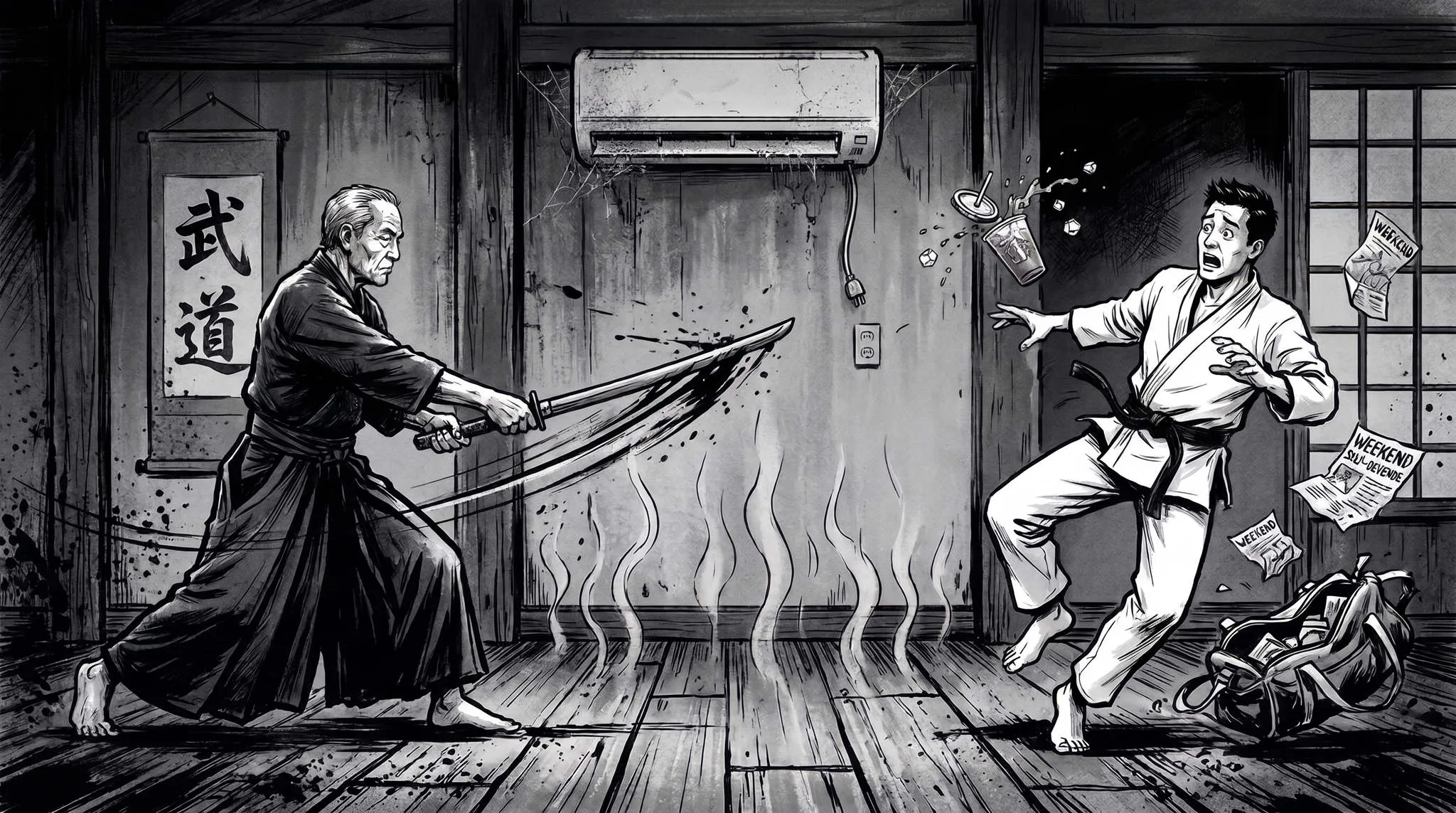
Before opening this series of texts on martial arts, I owe a small, strictly necessary clarification, mainly so no one assumes I am writing while levitating half a meter off the floor, wrapped in incense smoke and absolute wisdom. I am no grand authority holding the keys to the universe; I am simply a human being who has voluntarily stepped into a dojo since the age of five, paying in bruises and dignity for a long tour through different worlds, from Shotokan and Wadō-ryū Karate, to Judo and Wushu (a form of acrobatic ballet for people who dreamed of dancing Swan Lake, yet still wanted to hold a staff, or to play it even safer, a tin-foil sword for plausible deniability), before finally making a long stop in the Bujinkan. And from there, like a traveler who, after sampling every theme park on the map, finally decided to see the real forest, I returned to the root, to the classical Japanese martial arts, the Koryu (古流). What follows is not an instructional manual, but the field notes of a lifetime spent in practice, and an attempt to separate raw substance from the deafening, plastic noise of our era.
1. The Market of Fear and the Myth of Self-Defense
Modern Western man is an impressively optimistic mammal, completely convinced that every existential horror can be resolved through a contactless transaction. He wants to buy serenity in monthly installments, buy an identity on seasonal discount, and above all, buy safety, provided he never has to sweat, hurt, or come into awkward contact with the unpleasant nature of violence. Thus, martial arts in the West underwent a meticulous pasteurization process and were repackaged as a wellness product. The dojo ceased to be a place of confrontation with human fragility and evolved into a boutique of spiritual ergonomics, where you purchase a pre-packaged, harmless philosophy (gluten-free and risk-free), bundled with a strip of dyed cotton that, beyond holding your trousers up, promises to inflate your ego to hazardous atmospheric pressures.
The crowning masterpiece of this industry, of course, is the modern fairy tale of “self-defense.” I constantly come across posters for crash-course seminars along the lines of “Become Invincible by Sunday Noon (Coffee Break with Extra Sugar Included)” and I never know whether to laugh or report them to consumer protection. It is a touching pact of mutual delusion; instructors and students collaborate harmoniously to fool one another, though mostly to fool themselves. In what exact parallel universe do six hours over a weekend, or even a few months of leisurely exercise, prepare you to repel a frenzied, homicidal assault? The self-defense market sells the illusion of control to people who tremble at the dark reality of life, fiercely oppose gun ownership, and consider parking two blocks away, assuring them that savage violence gladly surrenders to clever tricks and choreographed wrist locks.
Unfortunately, human predation has the rude habit of blatantly ignoring the rules of sport sparring. The person waiting for you in a dark alley is not some mild-mannered accountant who simply lost his temper because the office printer jammed; he is a seasoned professional of brutality, thoroughly acquainted with the practical laws of survival and, to our great dismay, an accomplished master of basic arithmetic. He knows very well that to neutralize you without breaking a sweat, it is far more efficient to arrive with two or three colleagues than to show up alone. And if, out of some quirky professional preference, he decides to work solo, he will not arrive empty-handed, but in the discreet, metallic company of a weapon. The moment your brain grasps this grim asymmetry, the entire Western narrative of “defense” collapses with a loud thud. To see reality unfiltered, you must look back to eras where a tactical mistake did not cost you two points on a scoreboard and a chipped nail, but the privilege of maintaining a pulse.
2. The Raw Reality
When you finally decide to abandon the commercial fairy tales and step across the threshold of an authentic classical tradition, a Koryu (古流), the very first thing that dies on the spot is romanticism. You do not walk in there to discover your inner lotus flower, nor to align your chakras with the phases of the moon. The initial transmission of the art is refreshingly raw, cold, and cynically utilitarian; you walk in to learn how to fight and, preferably, how to remain in one continuous piece. And the first, decidedly impolite lesson it hands you is that in a real altercation, the very concept of “defense” is an extraordinarily bad idea.
Modern Western systems have trained the practitioner’s nervous system like an overly courteous doorman; wait for the gentleman to move, block his strike, absorb his energy respectfully, mentally consult the Penal Code, and once thoroughly assured of your moral superiority, go ahead and hit him already, he deserves it. This adorable choreography was born in peaceful societies equipped with functioning courtrooms; classical traditions regard it with appropriate horror. In a lethal environment, defensive thinking is merely an elaborate method of slow suicide. In feudal Japan, and elsewhere for that matter, people who insisted on granting their opponent the initiative and time to unleash his murderous fury had a very specific technical designation; corpses.
This is precisely where the logic of the preemptive strike emerges (Sensen-no-sen). Your survival does not depend on how gracefully you shield yourself, but on your capacity to read intent before motion even begins and demolish the attack at its inception. In a mortal encounter there is no room for chivalry; chivalry, after all, has always been a splendid theory formulated primarily by people standing safely far away from anything sharp. There is only efficiency and the geometry of survival. Which naturally raises a fair question; if Koryu is fundamentally a cold, mechanical manual for staying alive, how on earth did it get tangled up with all that profound philosophy currently printed on coffee mugs and self-help posts?
3. Friction with Death and Unlocking the Mind
The answer is disappointingly simple for lovers of mysticism; philosophy has absolutely no business at the starting line of the art. All those lofty concepts reminiscent of Zen, Taoism, or our own Stoics are not the user manual of martial arts; they are its unpredictable side effect. Reciting theoretical philosophical quotes in the West, without ever passing through the fire of practice, is roughly as useful as reading a thesis on hydrodynamics while drowning.
Real philosophy is born elsewhere; through daily, uncomfortably intimate friction with death. The human brain, in its factory settings, is essentially a panicked squirrel running on ancient survival firmware. Yet when you train day after day on the non-negotiable truth that a fraction of a second of hesitation means permanent shutdown, your nervous system is continuously exposed to the simulation of non-existence. Over time, this process acts like a vaccine; you develop a strange, practical immunity to the primal panic of the end. And right then, the exact moment the squirrel stops screaming, something clicks inside your core operating system (Kokoro no Gamae). The internal noise switches off, mostly because the Ego takes one look at the blade, runs a rapid cost-benefit analysis, and quietly exits the building. Suddenly, words like Fudoshin (the immovable mind) stop being exotic tattoos and become lived experience and cellular memory.
Of course, there is a small, irritating detail hidden in the fine print; this unlocking comes with zero guarantees. There is no timeline, and no customer service desk for complaints. Some may brush against it in ten years; others will not get close in two lifetimes. Whether it happens depends solely on your genuine humility and the scale of your hidden ambitions. The less you care about rewards, the more you simply show up, stay silent, faithfully mirror your teacher, and ask for nothing in return, the higher the odds that certain insights begin to germinate on their own inside you. As a marketing campaign, naturally, “Work brutally hard for decades and we promise you absolutely nothing” is a catastrophic commercial flop. And precisely because authentic tradition refuses to hand out promises, the most entertaining question of all arises; what happens when the dojo door is knocked on by people who survive exclusively on promises of greatness?
4. The Master’s Homeopathy and the Asceticism of Shugyo
Where the West eagerly buys the promise that “you will become a legend,” the East quietly rewards only excruciating patience and humility. Right inside this tectonic cultural rift, a marvelous ecosystem of eccentric, unstable, and deeply unhinged adults has flourished; people who watched a VHS tape in 1987 featuring a black-clad warrior and remain unshakably convinced they are two seminars away from vanishing in a puff of smoke (unfortunately, they failed miserably and remain stubbornly visible to the rest of us). Naturally, quite a few entrepreneurially gifted Eastern teachers lent a generous hand to this circus, taking one look at Western gullibility, immediately recognizing an untapped oil field, and opening a franchise chain.
Yet there is a far more devious, almost diabolically realistic reading of how a true, accomplished master handles this crowd. Think about it logically; if you have reached the summit of your art, why on earth would you become a social worker and ruin everyone’s fun by force? The authentic master spots the handful of serious students within the first five minutes and quietly, without fanfare, hands them the real keys to the art. Toward the “peculiar” ones, however, the ones who barge into the dojo with inflated egos and cinematic hallucinations, he applies something akin to homeopathy; instead of trying to “cure” them of their delusion, he pushes them even deeper into it.
He does not argue with them; he smiles serenely, hands out the flashy belts they crave so desperately, signs scrolls stamped with seven gold seals, crowns them “Supreme Grand Shadow Warriors of the 14th Dan,” and lets them sail happily toward their own shipwreck. Because if you are already hauling around such a counterfeit construct for a personality, that exact paranoia is your personal obstacle course. At the end of the day, all of us, madmen and sane alike, are attempting the exact same thing; to overcome our pathetic, petty selves. We simply do not start from the same basement. The unstable soul will be nudged by the teacher deeper into his megalomania until his demon either swallows him whole or jolts him awake; while the sane one will be relentlessly ground down through the endless, mind-numbing repetition of a single technique until his shoulders submit a formal written complaint, dragging you into a bureaucratic nightmare just to get it officially stamped and filed.
This is every person’s individual Shugyo (修行); the customized, harsh ascetic forging allotted to you by your own nature. The true path toward Satori does not arrive in gift wrapping, nor is it certified by a framed diploma on the wall. It passes exclusively through Keiko (稽古), the silent, thoroughly unphotogenic daily friction with the ancient form, and Kugyo (苦行), the raw practice of wear and hardship, the very difficulty that no promotional brochure imposes on you, yet you somehow muster the absurd courage to ask your teacher to assign to you.
♪ soundtrack
loads Bandcamp (third-party, sets cookies)