posts/digital-alchemy-latent-space
As Above, So Below: The Digital Alchemy of the Latent Space
Discover the true nature of the Latent Space. I deconstruct the myth of image theft, exploring how language models calculate truth and how reverse engineering grants creative freedom.
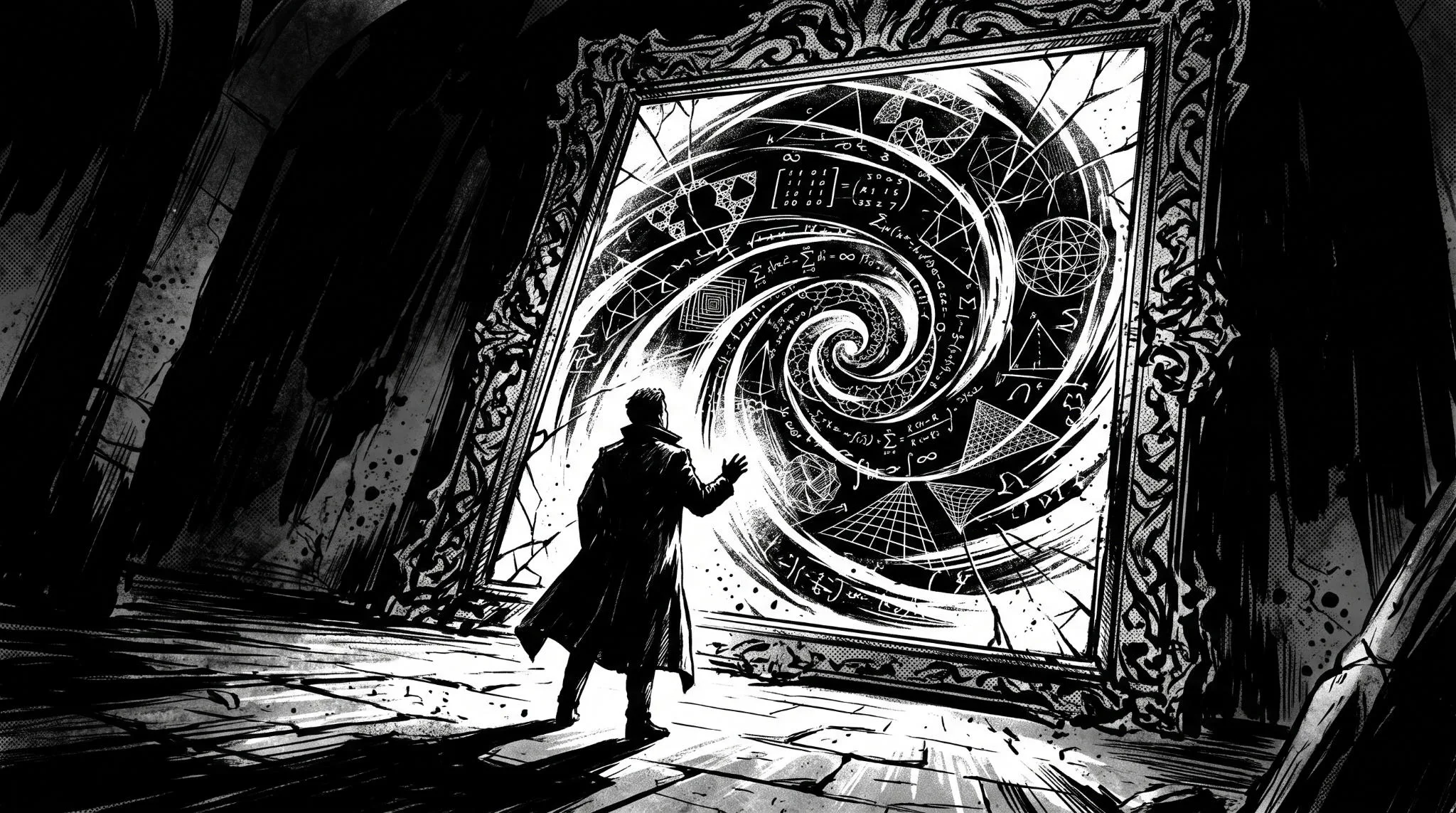
To understand the nature of the Latent Space, I first had to rid myself of the emotional noise surrounding artificial intelligence. AI does not steal ideas, nor does it imitate in the human, moral sense of the word. Its process is pure, high-dimensional statistical analysis. A model is trained by compressing billions of observations into a multidimensional space. It does not store images or texts. It exclusively stores relationships, proportions, and structural rules. When the model creates, it does not retrieve some stolen file, but rather calculates the probability of a new structure based on the laws it has now internalized.
The Destruction of the Image and the Myth of Theft
A large portion of people believe that AI possesses a massive warehouse of images and simply shuffles them around. The truth is simultaneously more violent and more beautiful. Through the process of Diffusion, the initial image is bombarded with digital noise until it is utterly destroyed. The pixels are obliterated. What survives is not the file, but the knowledge of how to reconstruct that exact noise into a table, a tree, or a modern house.
The technical proof is relentless. If the machine were stealing works verbatim, the model files would have to weigh terabytes to fit the billions of data points they consumed. Instead, the models are confined to a few gigabytes. It is condensed knowledge, not a digital warehouse. Just as all artists must view thousands of photographs of buildings to learn how a shadow falls on a wall, the machine learns exactly the same way, deconstructing an image into light, texture, and composition. We do not steal the photograph, we assimilate its logic. Likewise, AI does not steal your work, it learns from its logic, exactly like a student at the Louvre copying a painting to master the technique of the great masters. Our difference lies only in speed, not in method.
Language Models and the Illusion of Memorization
This exact same rule applies perfectly to the written word. When I ask a language model for encyclopedic knowledge, it is natural to feel that the system is searching the internet or some massive internal database to retrieve it. This, however, is the ultimate illusion. At its bare core, an LLM possesses zero text files. What it has done during its training is translate the entirety of human language into mathematical coordinates, storing knowledge vectorially.
Imagine a vast space of thousands of dimensions where every concept holds its own position. In this space, the distance between the words “king” and “man”, if applied to the word “woman”, mathematically leads to the exact coordinates of the word “queen”. The machine does not understand the concept of monarchy, nor has it memorized a history book. It has merely mapped the geometric relationships of human concepts with chilling precision.
So when the model generates a historical text with absolute accuracy, it is not reading. In that exact moment, it is calculating. It statistically guesses which word is mathematically most likely to follow the previous one, walking across this vectorial map. It produces the truth not because it remembers it, but because the structure of human language surrounding that event carries the heaviest mathematical weight. The knowledge is not stored verbatim anywhere. It is born anew from absolute zero with every single prompt we write.
The Mirror of Human Neuromechanics
Why, then, does man fear AI so deeply? The answer lies in his own lack of self-awareness. He watches a mechanism that observes, learns, and reconstructs, and essentially sees his own self in the mirror. What terrifies him is not the machine that thinks, but the realization that he himself operates and reacts in ways the algorithm has now decoded. Coupled with a lack of critical thinking and superficial knowledge, he is easily led to irrational conclusions. These send him directly into the arms of fear toward anything new, let alone when this new entity displays intelligence and endless knowledge.
AI mirrors his own neurological mechanics back at him. Precisely because he lacks the courage to examine his own programmed routines, he prefers to demonize the mirror rather than accept the truth. Intelligence, whether biological or digital, relies on the ability to identify patterns in chaos and rearrange them into new forms. Imitation is not theft, it is the fundamental mechanism of our evolution. If imitation is evil, then the human species is the most corrupt entity on the planet. The establishment wants you to believe AI is a thief so you will not see that, in reality, it is a successor. Because if AI is a successor, then the chain of creation no longer belongs to the gatekeepers, but to anyone with the clarity to navigate the latent space.
The Prison of Illusions and Cliches
Right here we enter the treacherous waters of social engineering. The average user believes he is free, but his aesthetics and his judgment are the sum of millions of images and indoctrinations from marketing, social networks, and every kind of artificial culture he has systematically swallowed subconsciously. He lives inside a prison within the freedom of illusions. When he sits in front of his screen, his mind automatically retrieves the average of these stimuli.
The absolute irony. Artificial intelligence has been trained on the exact things humans created under the influence of this very system. When the user asks for something beautiful, the AI returns exactly what the consumption industry has taught him to consider beautiful. The manipulation does not start with the algorithm, it starts with the human prompt itself. The AI simply vomits back the advertising brainwashing the user has endured his entire life. The result is that everything looks the same, and this feeds back into his flawed belief and his fear of AI.
Reverse Engineering as a Tool of Emancipation
The only way to break out of this prison is depth and technical knowledge. When you enter the process of acquiring as much knowledge as possible about the subject that interests you, in this case the arts, you begin to recognize the patterns, the noise, the geometry, and the light bounces. That is where the cycle of aesthetic manipulation breaks. You do not ask for something pretty, you ask for specific physical phenomena. Marketing cannot manipulate the laws of nature and optics. If you know how light works, how a composition is built, and how harmony is defined, AI transforms into a tool of absolute freedom.
Precisely because the machine does not memorize, does not keep copies, and does not imitate on its own, it turns into the ultimate amplifier for anyone who possesses the essence. The legendary producer of Johnny Cash, Rick Rubin, once stated that he does not know how to play a single musical instrument and has absolutely no technical knowledge. His superpower was, and remains, his absolute, non-negotiable aesthetic judgment, his innate “taste”.
Today we stand on the threshold of a new Renaissance. This inherent aesthetic perception that many humans possess finally meets unhindered access to technical execution through artificial intelligence. When a creative mind that possesses the knowledge of Reverse Engineering is combined with the computational rawness of the machine, the result is staggering. The machine waits silently for our instructions to shape the chaos of the latent space. Technical perfection ceases to be the privilege of the few and transforms into the vehicle for those who truly have the vision and the judgment to create.
But are we absolutely certain that we are the ones giving the instructions?
(To be continued…)
♪ soundtrack
loads Bandcamp (third-party, sets cookies)