posts/cyberia-trenches-of-hyperspace
Cyberia: Revisiting the Lost Trenches of Hyperspace
Reading Douglas Rushkoff's Cyberia in 1993 between an Amiga, a 486 PC, and stacks of underground vinyl: exploring the iconic cover, the five acts, and raw digital emancipation.
1993
In 1993 I was eighteen years old, anchored to the very last desk in the back row of my senior year in high school. While everyone around me was feverishly preparing for the national university entrance exams and their pre-packaged futures, I had a different habit: reading my own books during class, hidden right beneath the school textbooks.
My nights were spent staying up late in my room, bathed in the radiation of a bulky 17-inch SVGA CRT monitor, exploring a digital world that was just being born while another monumental chapter was preparing to close. My desk was split across a historic fault line: on one side sat the Amiga, right in the most critical and dramatic phase of its history before Commodore’s collapse, and on the other side hummed a 486 PC heralding the raw, cold architecture of the new era. Around the machines rose tall stacks of underground electronic and punk records, with the needle wearing down the grooves of Lhasa’s The Attic and Dave Angel’s 1st Voyage, the soundtrack to a nocturnal life where the only thing that truly occupied my mind was the next underground party.
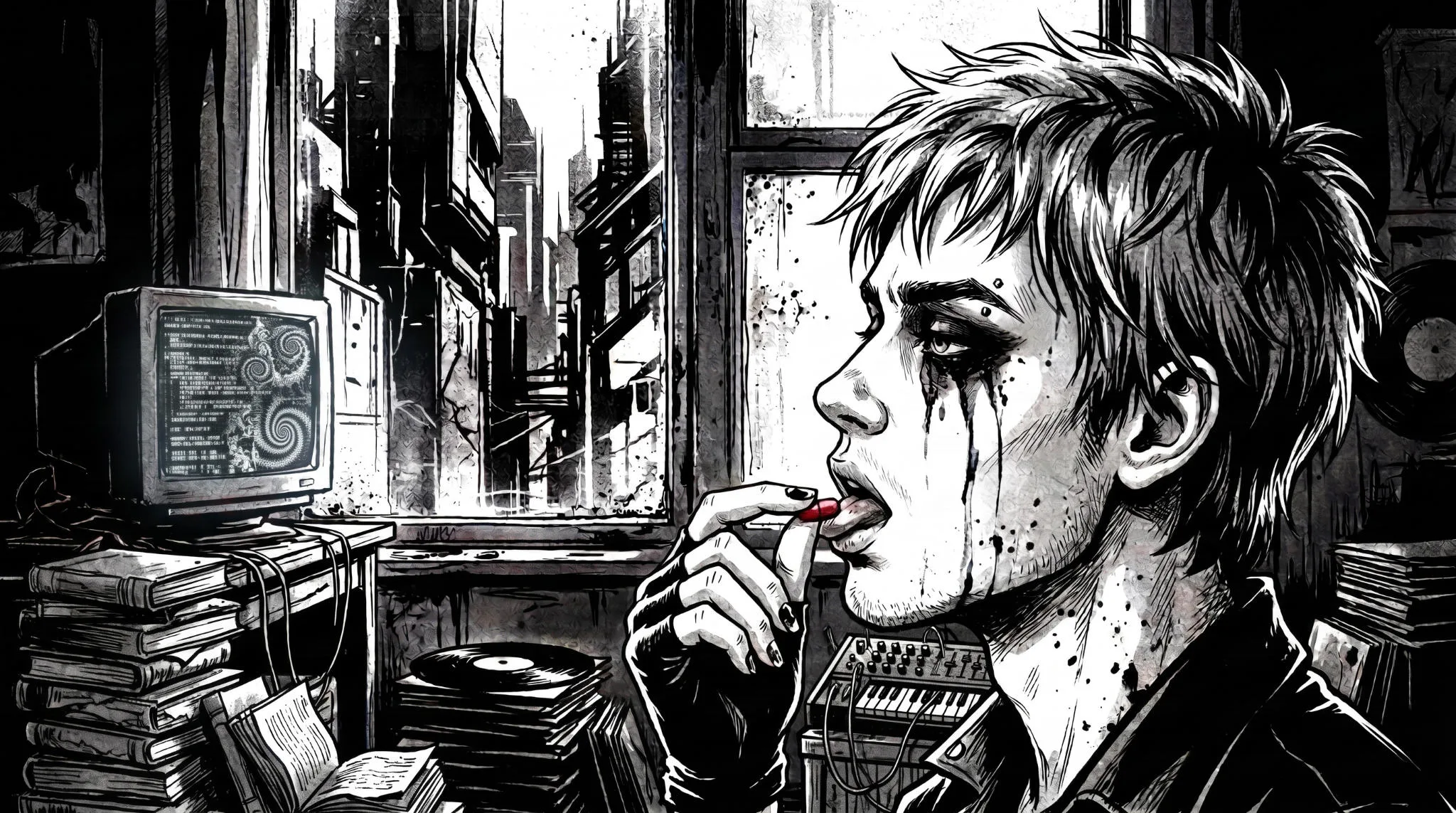
That year, the Greek edition of Cyberia: A Survival Guide in Cyberspace by American media theorist Douglas Rushkoff fell into my hands, translated by Lili Ioannidou and published by Livanis Editions (originally Cyberia: Life in the Trenches of Hyperspace, ISBN 9789602363843). Even before opening the first page, its legendary cover was enough to pull you in: a raw comic-art illustration of a girl in profile with spiky blue hair, dark blue lips, and smeared makeup running like tears down her cheek as she places a small red pill on her tongue. Long before The Matrix turned the red pill into a pop-culture cliché, that cover captured the exact aesthetic of our nineties room, a blend of post-punk melancholy, chemical experimentation, and nocturnal awakening behind a grungy window frame.
That book played a massive role for me. Hiding that unmistakable cover under my school desk, and bringing it back at night between the Amiga and the 486, was the validation that out there existed an entire tribe feeling the exact same pulse. Its yellowed paper acts today as a time capsule from an era when the digital river still flowed free, before it was dammed by corporate barriers, paywalls, and algorithmic cages.
In the early 1990s, the word “cyberspace” did not refer to social media platforms trading human attention. It was an unmapped frontier, a conceptual space in the trenches of which hackers, chaos theory mathematicians, information rebels, and explorers of consciousness met. Rushkoff did not merely document a technological trend; he mapped the birth of an underground scene that viewed code and nightlife culture as tools for existential emancipation.
The Alchemy of Silicon and Psychedelia
What made Cyberia speak so directly to my inner world, caught between the glow of the CRT screen and the vinyl grooves of underground electronic and punk tracks, was its organic synthesis of technology, philosophy, and the psychedelic vanguard. For the protagonists of the book, the computer was not a sterilized office machine. It was an amplifier of perception. Through the early BBS networks, the pages of Mondo 2000 magazine, and the electronic music scene, Mandelbrot fractals were treated as visual proof that nature, consciousness, and mathematics share the same secret web.
In Rushkoff’s narrative, cybernetics meets shamanism. Early internet culture believed deeply that the decentralization of information would dissolve hierarchical power structures, television network monopolies, and the linear control of industrial society. Cyperspace was the promise of a collective awakening.
Inside the Five Acts of Cyberia
To truly understand the fever dream of that era, one has to look at how Rushkoff structured his field report. The book unfolds across five distinct parts, each documenting a different trench of the underground.
In the opening section, dedicated to computers and the hacking underground, Rushkoff introduces us to the young keyboard cowboys of the WELL and the Legion of Doom. Stories of teenage phreakers routing around telecom giants mix with the early paranoia of state crackdowns and the Secret Service’s Operation Sundevil. Here, the personal computer is recast as a guerrilla weapon against institutional control, and the ethics of free information flow are forged in real time.
The second act shifts into the biochemical terrain of smart drugs, psychedelics, and botanical consciousness, echoing the exact visual of the book’s cover. We enter the kitchens of underground chemists in San Francisco, blending nootropics to match the processing speed of microchips, alongside figures like Timothy Leary and Terence McKenna. Psychedelia is no longer the escapist sixties counter-culture; it is reframed as high-tech cognitive debugging for navigating nonlinear realities.
In the third part, the book hits the dancefloor through technoshamanism and the rave scene. Rushkoff takes us inside illegal warehouse parties from London to the Bay Area, following characters like Fraser Clark and Psychic TV’s Genesis P-Orridge. The DJ booth becomes a cybernetic altar where acid house frequencies, fractal projections, and sleep deprivation synchronize hundreds of minds into a single, pulsing organism, proving that hyperspace could be experienced physically without a modem.
The fourth section explores the intellectual and artistic infrastructure of the movement: chaos mathematics, role-playing games, and DIY media. From the mathematicians in Santa Cruz mapping strange attractors to the eccentric headquarters of Mondo 2000 magazine and Boing Boing zine, we see how hypertext, cyberpunk literature, and desktop publishing allowed the underground to bypass mainstream media monopolies and author its own mythology.
In the final act, warriors at the edge of time, the narrative confronts the collision of Cyberia with the old world. Through stories of media viruses, Memetics, and virtual reality pioneers like Jaron Lanier, the book captures the exact moment when corporate agencies and intelligence networks began trying to co-opt the cyber-vanguard, leaving the tribe at a crossroads between commercial assimilation and deeper subversion.
From the Trenches to Digital Feudalism
Re-reading these pages today, from the vantage point of a solitary terminal, the irony of official history is stark. The trenches of Cyberia were paved over to build digital shopping malls. The decentralized protocols that once promised freedom were dressed in closed interfaces, turning active network explorers into passive consumers of content.
The optimism of the nineties had a blind spot: it believed that the architecture of the network alone was enough to guarantee freedom, underestimating the market’s ability to assimilate every counter-culture. Even Rushkoff himself, in his later works, was forced to sharply criticize the way Silicon Valley betrayed its original vision.
Why the Survival Guide Remains Relevant
Why, then, is it worth returning to that 1993 edition? Because “unofficial history”, what in Japanese tradition we call yashi, preserves the seeds that the dominant narrative tried to bury. Cyberia reminds us that the internet does not have to be what search engines and social networks serve us.
Surviving in cyberspace today requires a return to the roots of that first underground scene, with the exact same defiance we had at the back row desk: digital guerrilla warfare in the shadows of the networks, sabotage against algorithmic hypnosis, nocturnal complicity, and conscious insubordination against their pre-packaged world. Cyberia was never a geographical place or a commercial platform. It is the stance of those who choose to program their own reality, rather than being programmed by it.
https://rushkoff.com/books/cyberia.html
https://www.abebooks.com/9780062510105/Cyberia-Life-Trenches-Hyperspace-Rushkoff-006251010X/plp
https://metabook.gr/books/cyberia-odighos-epiviosis-ston-kivernokhoro-douglas-rushkoff-192457
♪ soundtrack
loads Bandcamp (third-party, sets cookies)
linked posts
The Art of the "Useless" Detail: From BBS and the Demoscene to Uncharted Waters of Code
A journey into the joy of digital exploration: BBS, ASCII art, the demoscene, Big Box covers, legendary adventures, cheat codes, and the nights when the world fit into 64 kilobytes.